Formerly: Balthazar & Son
Address: 581 Merchant Road
Year built: 1926
Architect: Unknown
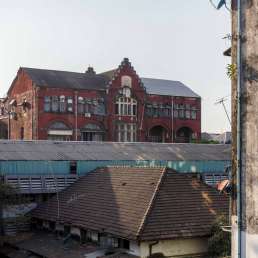
With business flourishing, Balthazar & Son expanded onto these adjacent premises on Merchant Road. This is clearly a more modern building, yet the design imitates its older red brick neighbour. Thanks to long-term use as an embassy, it has been regularly maintained and is in rather good shape today. It is simple and stately, with three floors and a bulky cut-stone portico greeting its visitors. The former tenants made some alterations, including tight window grilles on the ground floor and two walled-up windows on the third floor. Large antennas on the top floor hint at the building’s previous diplomatic functions.
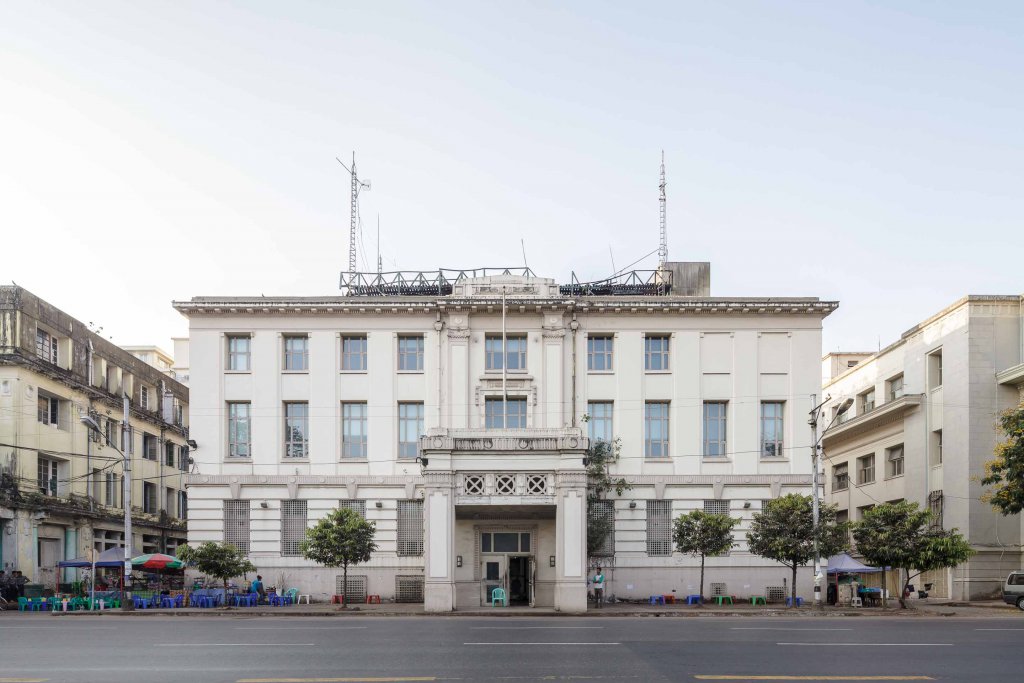
The US Embassy moved into these premises soon after Burmese independence. Burma was of utmost strategic interest to the Americans, who feared the spread of Communism in the region. They helped the Chinese Kuomintang regroup in the north of Burma, following their defeat by the Communist Party in the late 1940s. They supported preparations for a counterattack on Kunming, but this plan failed to materialise. As an unintended consequence, parts of Shan State became a hiding ground for these Chinese rebels, which led to the growing cultivation of poppy in the region. This haunts the Golden Triangle (the remote border areas between Myanmar, Laos and Thailand) to this day. Although the US ambassador at the time, William Sebald, denied knowledge of covert CIA operations on Burmese soil, Burmese Prime Minister U Nu was enraged and threatened to sever diplomatic ties between the countries.
In 1988, embassy staff witnessed the dramatic uprisings outside their window. When Burmese security forces opened fire on the demonstrators, Ambassador Burton Levin ordered the Marine Guards to open the door and let civilians seek shelter inside the grounds. The US did not replace Levin when he retired in 1990, reflecting the frosty bilateral relations that followed. A chargé d’affaires was to represent the United States in the following years. In 2012, Derek Mitchell was appointed the new US ambassador and Myanmar has become an important facet of the Obama Administration’s stated “pivot to Asia”. President Barack Obama visited the country in 2012 and 2014, both times delivering speeches at Yangon University. The administration began lifting sanctions on Myanmar in 2012 and is pouring aid money into the country, including in sectors that would have been inconceivable to support before 2011. For example, in 2014, the US aid agency committed to spending an eye-catching 20 million US dollars on “strengthening civil society and the media” in the country.

My first tour in the Foreign Service was US Embassy Rangoon, When I arrived in July of 1988, the country was very unsettled but peaceful. There were thousands of Burmese in the streets, demonstrating for elections they had been promised but never held. By August the entire country was on strike and everything was shut down. The authorities demanded that the demonstrations stop and the people return to work, which they refused to do. One morning in August I watched from my office window as snipers climbed to the roofs of adjacent buildings and opened fire on the people below. Those of us inside the Embassy ran to an interior hallway as soldiers shot their own citizens and bullets struck our building. This violence went on for weeks throughout Burma and nobody really knows how many people were killed in total. By September the military State Law and Order Restoration Council (SLORC) was in charge and the country was screwed. Apparently it’s still screwed.
The Embassy building had formerly been a bank and was located on Merchant Street in downtown Rangoon close to the waterfront. It was not in great shape; nothing in Rangoon was. There were 5 or 6 floors in the building, moss on the windows, most of which wouldn’t open, an elevator that didn’t work, crummy bathrooms and a spotty A/C system. I spent 2 years in that building. Thanks for the memories!!.
Fortunately, my memories of Yangon (formerly Rangoon) are more pleasant than Ellen’s. While the military rule was restrictive while I was there as well, it was a relatively calm peiod. Unfortunately, I understand that changed years after I left.
I was the NCOIC-in-Charge of the embassy Marine detachment from March 1977-March 1980. Originally, my then wife and infant son lived in the housing area on University Avenue where the current American Embassy is located. The Marine House and bar were also in the compound. Afer a year, my wife went back to the United States and I moved into the embassy apartment building further down University Avenue. It is also now gone.
My initial tour of duty was for eighteen months. However, I fell in love with the people, culture, country/city, and my job and asked to stay for an additional eighteen months. If the Marine Corps would have allowed, I would have stayed there indefinitely. It was the most memorable period of my life. I used to joke that if I could die in Burma, I’d die a happy man.
Some of my fondest memories were the everyday life and interacting with the local staff and citizens. I remember watching from my office window each morning as older Burmese residents did their Tai-Chi movements across the street in Maha Bandula Park. Of course, there are also fond memories of going to the Swedagon Pagoda and other historic locations. Also, to Bogyoke Aung San Market and the then “black market” to make purchases and haggle with the vendors. That was also fun. I even had t-shirts printed and sold at the Marine bar that said in Burmese “I’m not a tourist; I live here!” They helped lighten the sales pitch received at each vendor booth and added a bit of conversational humor to our interactions as the vendors laughed when reading the print.
I have never lost my love for Burma. In 2017, my wife and I, along with two friends who had never been to Asia, went back to Myanmar for a Pandaw river cruise down the Irrawaddy River from Mandalay to Bagan. It was sad seeing mold on the front and a tree growing out of the roof of the old embassy building. On the other hand, it was wonderful exploring Yangon and other places I had visited years before while introducing all three of them to “my” country. In fact, I am returing to Yangon again for a visit and 10-day Pandaw Irrawaddy Delta cruise in March of 2028. As I told my wife, I want to see the country and people one more time before I die. As Ellen said in her post…”Thanks for the Memories.”